
Owensboro Address Sources by Era
Owensboro house research crosses legal, map, household, and death records. Start with the newest parcel data, then step back through the Daviess County deed chain. Directories and census schedules add past residents who may never appear as owners. Each source answers a different part of who lived here before.
| Source | Years It Covers | Where Held | What It Shows |
|---|---|---|---|
| Daviess eCCLIX instruments | Many from 1974; 1966 target needs verification | County Clerk | Deeds, mortgages, plats, wills, legal description |
| Owensboro directories | Selected years, 1882-83 through 1987 | KHS, DCPL, WCKY | Dated occupants, trades, businesses, addresses |
| Federal census | 1790-1950 open under the federal rule | Archives and DCPL databases | Households, ages, relations, work, geography |
| LOC Sanborn map | 1890 inspected sheet | Library of Congress | Building, street, use, and block context |
| Obituary and probate | Index since 1977; other series vary | DCPL, clerks, KDLA | Death, heirs, estate, and address clues |
The 1865 Daviess courthouse disaster can interrupt early work. A later deed, tax entry, church record, newspaper, cemetery source, family paper, or abstract may bridge a gap. Absence from one book is not proof that no one lived at the site.
Start With an Owensboro Parcel
The OMPC Locator Map can orient the search before any name is pursued. Capture parcel ID, map number, property and mailing addresses, subdivision, lot, plat, and deed book and page when shown. These fields prevent similar street addresses from being mixed.
A site address locates land. A mailing address routes tax correspondence. The legal description identifies the tract. None alone proves who occupied a house. That is the first safeguard when tracing Owensboro previous residents.
Trace Daviess Deeds Backward
The deed chain starts with the current parcel owner, then uses the County Clerk index to find that owner's purchase. A legal description is more stable than a street label. Record every instrument reference before moving back another generation.
- Copy parcel, map, legal-description, and deed-reference fields from OMPC or PVA.
- Search the current owner as grantee in eCCLIX and find the purchase deed.
- Record grantor, grantee, date, instrument or book and page, description, and prior reference.
- Search that seller as grantee to find the prior purchase, then repeat.
- When online coverage ends, ask the Clerk about copies or use KDLA and microfilm.
- Grantor and grantee
- The grantor transfers an interest; the grantee receives it.
- Chain of title
- The linked series of transfers for one tract.
- Legal description
- The deed's land description, often stronger than an old street number.
The eCCLIX landing page requires an account and supports document viewing and printing.
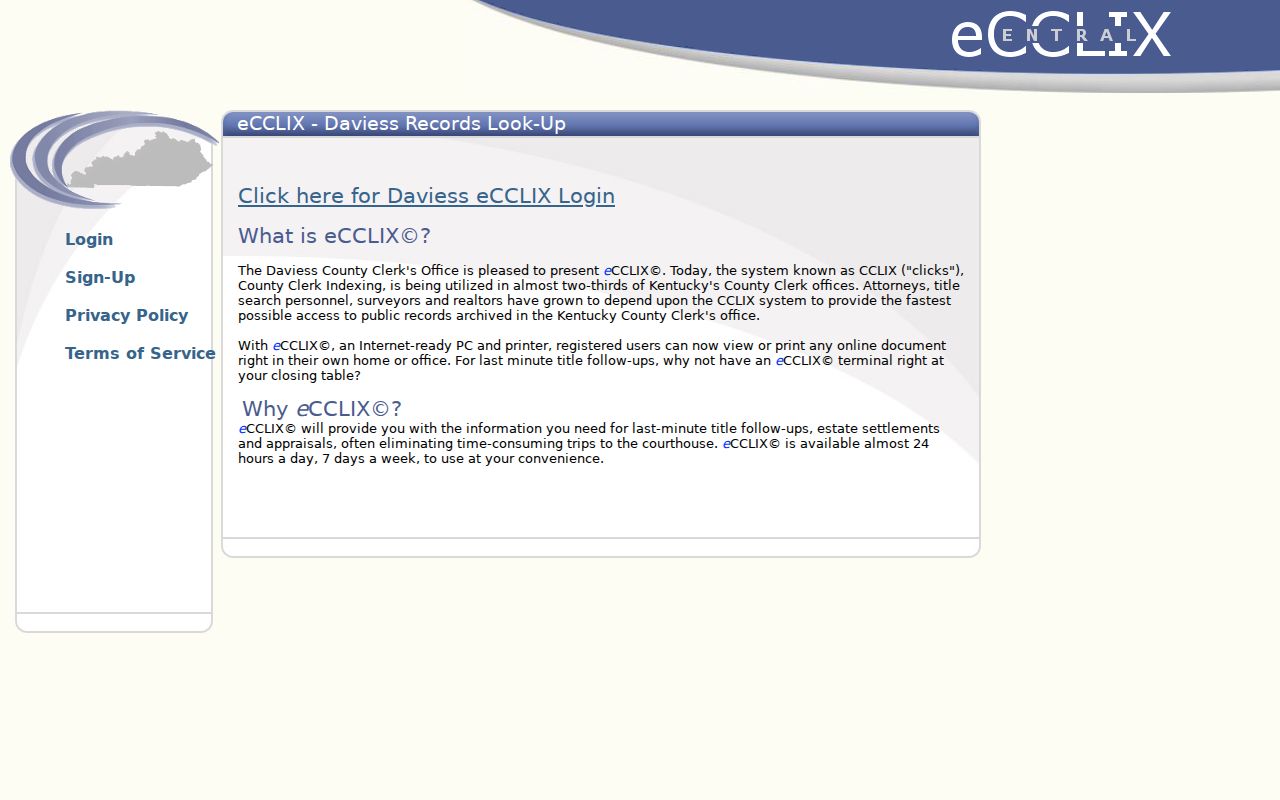
The landing page does not prove the current cutoff, so verify coverage after login.
Where Owensboro's Index Stops
A 2023 County Clerk notice said many records were available from 1974 and described a target to reach June 30, 1966 by June 2026. That was a target, not a safe current cutoff. Confirm the authenticated portal range.
For older work, contact the Daviess County Clerk land-records office for office and copy routes. KDLA's deed guide explains reverse-chain research, while archives and microfilm can extend the trail. A precise book, page, instrument, name, and date makes a request stronger.
Note: Record the date on which portal coverage was checked, since digitization continues.
Pair Owensboro Directories and Census
KHS lists directories for 1882-83, selected years from 1889 through 1935, 1973, and 1983 through 1987. WCKY finding aids add river-directory years. The federal census is open through 1950 under the 72-year rule. Together, these sources identify previous residents who may not own the parcel.
- Find the address in the nearest available directory and copy the dated entry.
- Compare the same street in the census year before or after it.
- Track names, ages, relations, and occupations without merging years.
- Check the next directory for a move, name change, or business use.
- Use deeds, obituaries, or probate to test the resulting trail.
The collections are detailed on the Owensboro city directory page. Here they serve one address timeline.
Owensboro's 1890 Block Check
The 1890 Sanborn map adds a physical check. It can show a building footprint, street, and use at that moment. Compare it with a directory from the same era before assuming a modern address points to the same structure.
No official citywide street-renumbering conversion schedule was found. When an old number fails, compare the directory street guide, Sanborn sheet, plat, deed, National Register survey, and modern OMPC layer. A mismatch calls for more proof, not a guess.
Owensboro Previous Residents After Death
The Owensboro Obituary Index covers newspapers since 1977, with online live indexing beginning in 2006. Search by name and date, then check the cited newspaper because index errors can occur. It is a citation tool, not a certificate.
Probate may name heirs, an estate, property, or a sale. Cemetery sources can add burial dates and grave locations. Potter's Field has large gaps because original records were not kept. A missing name does not prove a person was not buried there. Such endpoints can explain why past residents vanish from later years.
Owensboro Households Need Two Trails
Ownership and occupancy must be built as parallel timelines. Deeds identify legal transfers. Directories and census schedules identify dated households. Permits may add improvement dates and project roles, but no citywide permit archive start date was confirmed.
No official Owensboro house-history guide was found. DCPL local history, KHS directories, LOC maps, Clerk and PVA offices, OMPC, KDLA, and the obituary index form the fallback chain. Keep notes for each source year, spelling, and address form.
Lawful use. Research Owensboro previous residents for house history, family history, or a personal record question. Never use the trail to track or harass a living person.
The 1865 Owensboro Records Gap
A backward address trail can fail for reasons that have nothing to do with the people who lived there. The Daviess County courthouse burned in January 1865, and the surviving county record sequence reflects that loss. A missing early deed, court paper, or tax reference therefore cannot be treated as proof that a parcel had no owner or that an Owensboro household was absent. It is a records-survival problem that calls for a different source rather than a guessed name.
Work forward from the earliest surviving instrument and backward from a later, verified conveyance. A later deed may recite an earlier owner, boundary, adjoining tract, plat, or deed-book reference. Tax material can place a named owner near a property in one year, while a city directory can add an occupant and occupation for another year. Historic maps, newspapers, church records, cemetery material, probate files, and abstracts can bridge an interval, but every item should retain its own date and role. None silently replaces the lost original.
Fallback order for an older Owensboro address: ask the Daviess County Clerk about the office index and surviving books; check the Daviess County Public Library local-history collection and directory volumes; then use the Kentucky Department for Libraries and Archives request route for series-specific county records. KDLA states that archival requests can take four to six weeks and may involve a nonrefundable research fee plus copy and postage charges.
Street identity also needs testing. Owensboro developed from Yellow Banks, and an old description may use a former street name, a corner, a landmark, a lot-and-block description, or adjoining owners instead of today's address. Preserve the wording from the record, compare it with the legal description and map evidence, and state uncertainty when the old site cannot be matched confidently. That method produces a defensible previous-residents timeline even when the archive has a real break.